
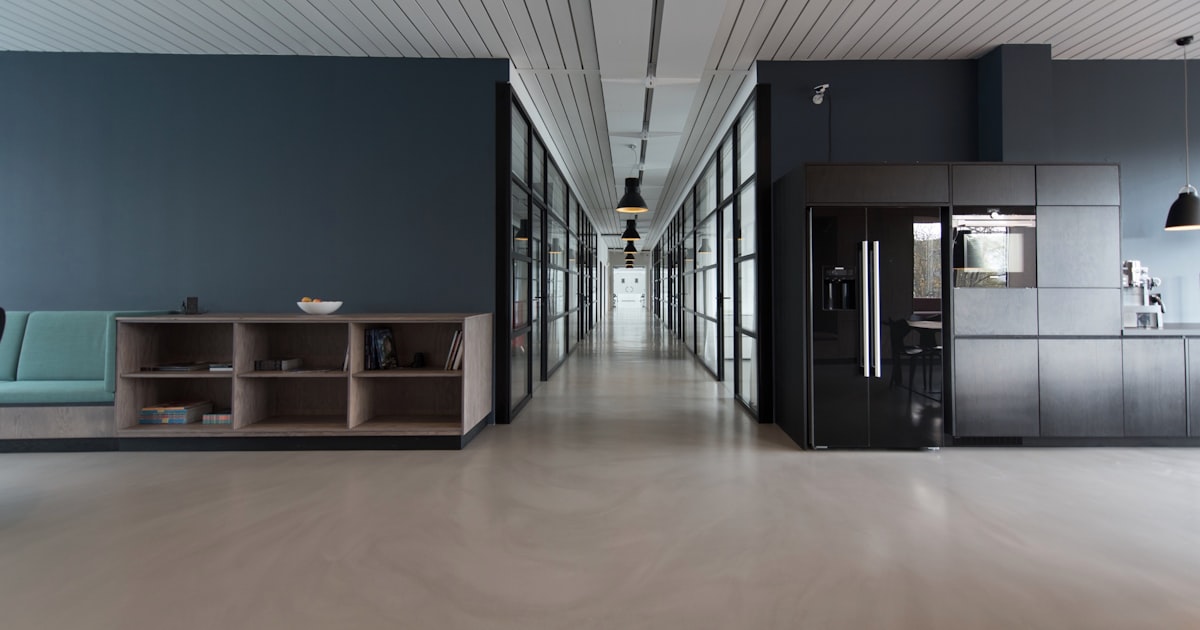
The flooring specification for a commercial space is rarely a straightforward decision. It sits at the intersection of aesthetic ambition, mechanical performance, budget constraint, and maintenance reality. For specifiers navigating this terrain, two broad system categories dominate the conversation: cementitious coatings — polymer-modified cements, microcements, and cementitious overlays — and epoxy resin systems. Understanding the fundamental differences between these chemistries is essential to making an informed selection.
Chemistry and Cure Mechanisms
Epoxy floor systems are thermosetting polymers formed by the reaction of an epoxide resin with a polyamine or polyamide hardener. This cross-linking reaction produces a rigid, non-porous film with exceptional chemical resistance and compressive strength. The cure is exothermic and irreversible — once set, the material cannot be re-softened or reworked.
Cementitious coatings, by contrast, are hydraulic binders. Their primary cure mechanism is the hydration of Portland cement, supplemented by the film-forming properties of polymer additives — typically acrylic or styrene-butadiene emulsions. This dual cure produces a material that is breathable, flexible, and mineralogically compatible with concrete substrates. The polymer phase provides tensile strength and adhesion; the cement phase provides compressive strength and abrasion resistance.
Aesthetic Character
Epoxy systems offer a high-gloss, seamless finish that reads as distinctly synthetic. The surface is impervious, reflective, and uniform — qualities that suit pharmaceutical facilities, food processing plants, and industrial warehouses where hygiene and chemical resistance are paramount.
Cementitious coatings produce a markedly different aesthetic. The mineral matrix creates depth, variation, and a tactile quality that synthetic polymers cannot replicate. The surface may be matte, satin, or polished, but it always retains the organic character of its cementitious origins. This quality has made microcement and decorative cement coatings the material of choice for hospitality, retail, and residential projects where aesthetic sophistication is valued.
UV Stability and Yellowing
One of the most significant differentiators between the two systems is their response to ultraviolet radiation. Standard bisphenol-A epoxies are notoriously UV-unstable. Exposed to sunlight, they yellow, chalk, and lose gloss — a degradation process that is cosmetically unacceptable in any space with natural light. Aliphatic polyurethane topcoats can mitigate this issue, but they add cost and complexity.
Cementitious systems, being mineral-based, are inherently UV-stable. Their colour is derived from inorganic pigments — iron oxides, titanium dioxide, carbon black — that do not degrade under ultraviolet exposure. A microcement floor installed in a sun-drenched retail space will retain its colour and character for its entire service life without topcoat-dependent UV protection.
Moisture Tolerance
Epoxy coatings are impermeable vapour barriers. When applied over concrete substrates with residual moisture, they trap water vapour at the bond line, creating hydrostatic pressure that leads to blistering and delamination. This failure mode is so common that moisture testing (typically via ASTM F2170 relative humidity probes) is a mandatory pre-application step for every epoxy installation.
Cementitious coatings are inherently vapour-permeable. Their open pore structure allows moisture to migrate through the coating film without compromising adhesion. This characteristic makes them significantly more forgiving on substrates with marginal moisture conditions — a practical advantage in tropical climates where achieving the low moisture levels demanded by epoxy systems can delay project timelines by weeks.
Thermal and Structural Movement
The coefficient of thermal expansion for cured epoxy resins differs substantially from that of concrete. This mismatch means that as temperatures cycle — particularly in buildings without climate control — the epoxy film expands and contracts at a different rate than the substrate beneath it. Over time, this differential movement generates shear stress at the bond line, increasing the risk of edge lifting and delamination.
Polymer-modified cementitious coatings share their thermal expansion characteristics with the concrete substrate, because both are fundamentally mineral matrices. This compatibility minimises thermally induced stress and contributes to the long-term durability of the coating-substrate bond.
Repair and Maintenance
When an epoxy floor sustains localised damage — a chip, a scratch, a chemical spill that exceeds the system's resistance — the repair is conspicuous. Colour matching is difficult, and the boundary between old and new material remains visible. Full-area recoating is often the only path to a uniform appearance.
Cementitious coatings can be locally repaired with relative ease. Because the material is applied by hand with steel trowels, skilled applicators can blend new material into existing surfaces, creating repairs that are effectively invisible after topcoat application. This repairability extends the economic life of the system and reduces lifecycle costs.
The Specification Decision
Neither system is universally superior. Epoxy excels in environments that demand chemical impermeability, high compressive strength, and hygienic surfaces — industrial facilities, laboratories, commercial kitchens. Cementitious coatings excel where aesthetics, breathability, UV stability, and substrate tolerance are priorities — hospitality, retail, residential, and mixed-use commercial spaces.
The specifier's task is to match the system to the environment. The best outcomes emerge when this decision is made early in the design process, with full consideration of the space's functional requirements, environmental conditions, and long-term maintenance expectations.