
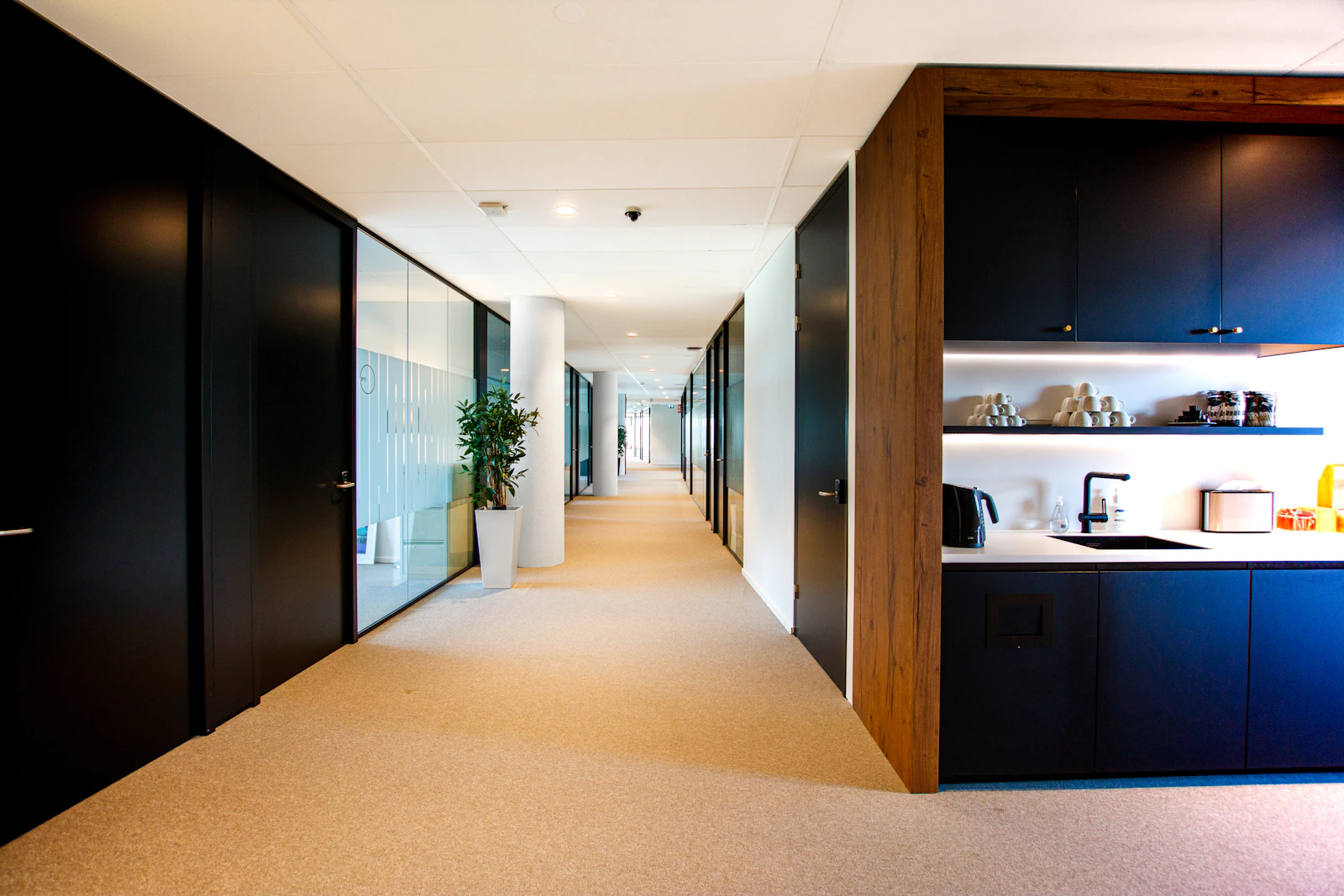
The Overlooked Power of Commercial Corridor Design
In the race to perfect hotel lobbies, retail showrooms, and office reception areas, designers and developers often direct their most ambitious material choices toward destination spaces — the rooms, suites, and flagship floors that guests and tenants remember most. Corridors and walkways, by contrast, tend to receive the residual budget and residual attention. Yet these transition spaces account for a staggering proportion of the total floor and wall area in any commercial development. In a mid-size Philippine hotel with twelve floors, a resort spanning several hectares, or a regional mall with multiple wings, corridor and walkway surfaces can easily represent tens of thousands of square meters of untapped design canvas.
The emerging discipline of commercial corridor design recognizes what hospitality consultants and retail strategists have long understood: the quality of a journey shapes the perception of its destination. When a guest walks a corridor that feels cohesive, tactile, and visually deliberate, their anticipation for what lies at the end intensifies. When a shopper moves through a passage that feels worn, inconsistent, or generic, subconscious dissatisfaction begins to accumulate before they even reach the store they came to visit. Architectural coatings — applied with precision to both vertical and horizontal surfaces — are one of the most powerful and cost-efficient tools available to close this gap.
Why Transition Spaces Demand a Coating Strategy
Commercial corridors and walkways face a uniquely punishing combination of demands. They must endure continuous foot traffic — sometimes around the clock in hotels and transport-adjacent retail — while maintaining visual integrity across years of use. They must perform against humidity, cleaning chemicals, and in many Philippine outdoor developments, direct exposure to heat and intermittent rain. They must also communicate brand identity with the same consistency as any other designed element in the property, even as they serve a purely functional purpose.
Generic paint and ceramic tile have historically been the default response to these demands. Both fall short. Paint chips, scuffs, and fades with accelerated speed in high-traffic corridors. Ceramic tile introduces grout lines that accumulate grime, interrupt visual flow, and become maintenance liabilities over time. The result is a surface that looks dated within a few years and requires costly, disruptive refurbishment cycles — an outcome that no property developer or asset manager welcomes.
Modern architectural coating systems offer a fundamentally different value proposition: surfaces that are engineered for longevity, designed for aesthetics, and applied with the kind of seamless continuity that transforms a passage into a spatial experience.
Seamless Flooring for Commercial Walkways: The Case for Microcement
For interior walkways, corridors, and covered commercial passages, seamless flooring has become the benchmark specification for premium properties. The logic is straightforward. A continuous, grout-free floor surface eliminates the visual interruption of tile joints, reads as a single unified plane regardless of corridor length, and presents a dramatically simpler maintenance profile. There are no grout lines to seal, regrout, or replace. There are no tile edges to lift, crack, or chip. There is simply surface — consistent, durable, and purposefully finished.
Microcement achieves exactly this. As a trowel-applied seamless coating available in both Coarse and Fine textures, it bonds directly to prepared substrates and creates the kind of uninterrupted horizontal plane that elevates a corridor from functional to architectural. In hotel guest floor corridors, where the flooring must speak quietly but confidently alongside wall treatments and lighting design, a Fine-texture Microcement in a warm neutral registers as intentional luxury without competing with artwork or branded signage. In retail passages and food hall walkways, a Coarse-texture application offers additional slip resistance while maintaining the clean, contemporary aesthetic that modern tenants and shoppers expect.
Beyond aesthetics, Microcement's performance credentials make it a rational choice for commercial corridor applications. It is suitable for both indoor and outdoor use, which means a single system can carry a coherent flooring language from an interior lobby corridor through a covered external walkway without material discontinuity. For resort developments in particular — where the journey between villas, restaurants, pools, and amenity buildings is a designed experience in itself — this continuity of surface is an enormously valuable design instrument. Explore flooring applications to understand the full range of environments where this system performs.
Texture as Wayfinding
One underutilized dimension of seamless flooring in commercial corridors is the use of texture variation as a wayfinding signal. By specifying a shift in Microcement texture — from Fine to Coarse, or from a lighter tone to a slightly deeper one — at corridor junctions or threshold moments, designers can create intuitive navigation cues that function without signage. Guests unconsciously register the change underfoot and associate it with a directional or spatial transition. This is particularly valuable in large resort complexes and multi-wing shopping centers where directional signage alone creates visual clutter.
Vertical Surfaces: Bringing Corridor Walls into the Design Language
A corridor experience is never purely about the floor. The wall surfaces that line a passage for its entire length are the dominant visual field for anyone moving through that space. In a typical commercial corridor, a person's eye spends far more time reading the walls than the floor — walls are at eye level, they carry lighting fixtures and artwork, and they frame every door and threshold. If the floor is elevated to a seamless, purposeful surface and the walls remain painted plaster, the disconnect is immediately apparent.
For exterior-facing corridor walls, boundary passage walls, and open-air walkway structures — common in Philippine resort developments and mixed-use outdoor retail — Opus delivers a sintered sand and polished concrete aesthetic that performs confidently in direct exterior exposure. Its natural stone character aligns with the material vocabulary of premium hospitality and lifestyle developments, and its suitability for outdoor vertical surfaces makes it a natural specification wherever covered external walkways meet facade-grade conditions. The result is a passage that reads as an architectural continuation of the building's exterior rather than a functional afterthought inserted between destination spaces.
For interior corridor walls in hotels, condominiums, and office developments, the specification priorities shift toward refinement and brand expression. In luxury hospitality projects, feature wall treatments along elevator lobbies and VIP corridors can deploy Liquid Polish to create the kind of mirror-like, Venetian plaster-inspired reflective finish that signals genuine material investment. Applied as an accent on end walls, lift lobby facings, or corridor termination points, Liquid Polish introduces depth, luminosity, and a tactile presence that elevates the entire passage — without requiring the full-corridor application that would overwhelm a narrow space. Learn more about wall coating applications and how they integrate with commercial interior schemes.
Consistency Across Zones: The Brand Corridor Principle
The most sophisticated commercial developments in the Philippines — from the integrated resorts of Parañaque to the lifestyle malls of Bonifacio Global City — understand that brand consistency must extend into every square meter of a property, including its corridors. The material palette used in a lobby, a restaurant interior, or a hotel room should have a recognizable echo in the passages that connect those spaces. Coatings make this achievable without the prohibitive cost of replicating premium stone or timber across every surface.
A resort that uses natural stone on its lobby feature walls, for example, can carry that material language into covered walkways using Opus on exterior passage walls — achieving the same visual register at a fraction of the cost and with far greater practical resilience against the Philippine climate. A hotel that specifies Microcement flooring in its restaurant and bar can extend that seamless surface into connecting corridors, creating a cohesive journey from arrival to dining that feels curated rather than assembled. This principle — that coatings enable brand-level material consistency at commercial scale — is one of the primary reasons they have become a specification preference among leading architects and interior designers working on large hospitality and retail projects.
Outdoor Walkways and Pool Deck Connections: Performance Underfoot
Philippine resort and hospitality developments routinely feature extensive outdoor walkway networks — paths connecting pool areas, beach access routes, garden passages between amenity buildings, and landscaped approach routes from car parks to hotel entrances. These surfaces must perform against heat, rain, salt air, pool water splash, and the kind of barefoot or sandal-shod traffic that demands genuine slip resistance.
For these horizontal outdoor surfaces, aggregate-based systems designed specifically for landscape and exterior flooring environments are the appropriate specification. Mineral Sand Flooring delivers the slip-resistant, durable, outdoor-grade performance that resort walkway applications require, with an aesthetic that complements natural landscape settings and the tonal vocabulary of high-end resort design. Its suitability for pool decks, driveways, and commercial landscape surfaces makes it a practical complement to the coating systems used on the adjacent vertical and interior surfaces of a resort corridor network.
Specifying for Longevity: Why Coating Choice Is a Financial Decision
Property developers and asset managers evaluating coating specifications for corridors and walkways should approach the decision not as an aesthetic preference but as a lifecycle cost calculation. The refurbishment cycle for a corridor finished in standard paint and ceramic tile in a high-traffic commercial environment typically runs between three and five years before visible degradation demands intervention. Each refurbishment cycle involves material costs, contractor fees, and — critically — disruption to operations. In a hotel, closing a guest floor corridor for resurfacing has a direct impact on room availability and revenue.
Architectural coating systems applied to properly prepared substrates, maintained according to manufacturer guidance, and specified to match the environmental demands of the surface in question operate on dramatically longer maintenance cycles. The upfront cost premium over commodity materials is real, but it is routinely recovered within the first or second cycle that a competing specification would have required. For a property developer managing a portfolio of assets across multiple Philippine commercial developments, this lifecycle advantage compounds significantly.
Designing Corridors That Earn Their Square Meters
The most compelling argument for investing in commercial corridor design is ultimately experiential rather than financial. Spaces that feel considered — where the floor reads as continuous and intentional, where the walls carry material character rather than generic neutrality, where the transition from one destination to the next feels like part of a designed journey — generate measurable differences in how occupants, guests, and customers perceive the entire property.
In the competitive landscape of Philippine commercial real estate, where hospitality, retail, and mixed-use developments are increasingly judged on the quality of their holistic tenant and guest experience, corridors and walkways are no longer spaces that can be designed by default. They are, in the hands of architects and designers who understand the full palette of modern architectural coatings, an opportunity to extend brand identity, enhance wayfinding clarity, and demonstrate material integrity across every meter of a property's footprint.
The coating systems exist. The application expertise is available. The design logic is established. The question is simply whether the next project will treat its corridors as afterthoughts — or as the curated architectural transitions they have the potential to become. Explore TechStone's full range of architectural coating solutions at techstone.com.ph and browse completed commercial projects at our project gallery.