
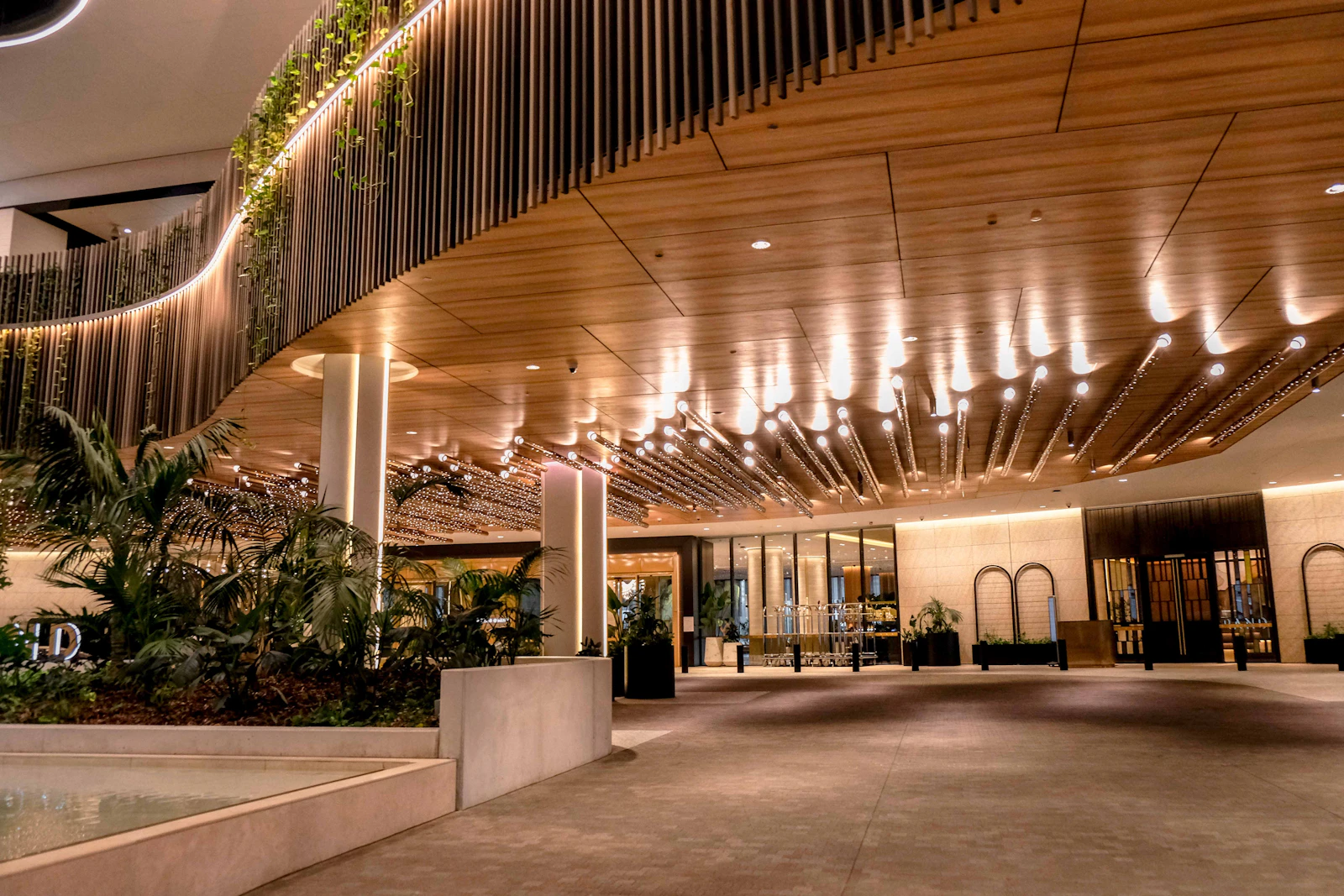
Why Philippine Hotels Are Rethinking the Full Renovation
The Philippine hospitality industry is in the middle of a quiet revolution. As travel rebounds strongly post-2025 and competition for premium guests intensifies across Metro Manila, Cebu, Boracay, and Palawan, hotel owners and property managers face a familiar dilemma: the lobby looks dated, but a full gut renovation means weeks of downtime, displaced guests, and capital expenditure that can stretch into the tens of millions of pesos.
Forward-thinking architects and interior designers have found a smarter path forward. Strategic hotel lobby renovation using high-performance decorative coating systems can deliver a dramatic, five-star aesthetic transformation in a fraction of the time and cost. The results — when executed with the right materials and the right expertise — are often indistinguishable from a complete rebuild. In many cases, they are more refined.
This guide is written for the architects, interior designers, property developers, and contractors who are planning mid-year property upgrades and want to understand exactly how luxury interior coatings can redefine a hospitality space from the inside out.
The True Cost of Doing Nothing
Before exploring solutions, it is worth naming the problem clearly. A hotel lobby is the single most powerful first impression a property makes on a guest. Research from the hospitality industry consistently shows that guests form a judgment about a hotel's quality within the first 90 seconds of entering. Worn surfaces, dated finishes, and visually disconnected design elements signal neglect — regardless of how excellent the rooms or service may be.
In a market where OTA review scores directly influence occupancy rates and average daily rates, a tired lobby is not a cosmetic issue. It is a commercial liability. Yet the traditional answer — strip everything out and start again — carries its own risks: extended closure periods, cost overruns, supply chain delays, and the disruption of ongoing bookings.
The emergence of advanced architectural coating systems has fundamentally changed the calculus. Commercial space transformation is now achievable through precision surface application, without structural demolition, without extended hotel closures, and with a per-square-meter cost that opens up investment possibilities that full renovation simply cannot offer.
Feature Walls: The Highest-Impact Starting Point
If a hotel lobby has one anchor element that sets the tone for everything else, it is the feature wall. Whether it frames the reception desk, defines the lounge seating area, or greets guests as they step through the entrance, the feature wall carries enormous visual weight.
This is precisely where feature wall finishes of the highest caliber make their impact felt most immediately. For luxury hotel applications, Liquid Polish — TechStone's Venetian plaster-style coating — is one of the most powerful tools available to designers working on premium interiors.
Liquid Polish: Mirror-Like Refinement for Five-Star Lobbies
Liquid Polish creates a deeply reflective, layered surface finish that replicates the luminous quality of traditional Venetian plaster, achieved through a trowel-applied process that builds subtle texture and depth across the wall surface. The result is a finish that catches and moves light in a way that painted surfaces or standard plasterboard simply cannot replicate.
In a hotel lobby context, a Liquid Polish feature wall behind the reception counter creates an immediate sense of material richness. The reflective quality amplifies available lighting — both natural and artificial — making spaces feel simultaneously larger and more intimate. For hotel lobbies that suffer from low ceilings or limited natural light, this effect is genuinely transformative.
Liquid Polish is a wall-applied system suitable for indoor environments, making it ideally suited to hotel lobbies, executive lounge feature walls, high-end restaurant interiors, and spa reception areas. Its finish is available across a curated palette, allowing designers to align the wall's tone with the hotel's brand identity — from warm champagne and ivory tones for classic luxury properties to deep charcoal and slate for contemporary boutique concepts.
Explore the full range of possibilities at TechStone's wall applications.
Lobby Flooring: Seamless Surfaces That Signal Sophistication
The floor of a hotel lobby endures extraordinary abuse — heavy foot traffic, luggage wheels, cleaning chemicals, and the constant movement of trolleys and service carts. But it is also one of the most visually prominent elements in any interior space. Guests see it continuously as they move through the lobby, and its condition and finish communicate volumes about the property's standards.
Traditional flooring solutions — marble, large-format tiles, timber — come with significant challenges in a renovation context: weight loading concerns, grouted joints that harbour dirt and require ongoing maintenance, and the structural disruption of removal and replacement.
Microcement: Seamless Flooring for High-Traffic Hospitality Spaces
For hotels seeking to refresh their lobby flooring without demolition, Microcement offers a compelling solution. Applied directly over existing substrates — tiles, concrete, screed — Microcement creates a continuous, grout-free surface that visually expands the space and dramatically simplifies ongoing maintenance.
Available in both Course and Fine textures, Microcement can be calibrated to the specific aesthetic requirements of the project. Fine texture finishes deliver the polished, seamless look associated with luxury contemporary interiors. Course texture applications provide subtle tactile interest while maintaining the material's characteristic visual coherence.
The practical benefits for a hospitality property are significant. Grout lines in traditional tiled floors are notoriously difficult to maintain in pristine condition under heavy commercial use — they discolour, accumulate bacteria, and signal age very quickly. A seamless Microcement surface eliminates this maintenance burden entirely. The surface is also highly compatible with underfloor heating systems, an increasingly relevant specification for hotel lobbies in cooler highland destinations such as Baguio.
Microcement is equally effective on lobby walls, allowing designers to carry the same material language from floor to wall and create the kind of unified, architectural interior aesthetic that defines contemporary luxury hospitality design. Its applicability across both surfaces makes it one of the most versatile tools in a designer's material specification kit for commercial space transformation.
The Strategic Coating Upgrade: A Phased Approach
One of the most underappreciated advantages of decorative coating systems over traditional renovation is the ability to execute transformations in phases — working around the hotel's operational calendar without requiring full closure.
A well-planned coating upgrade can proceed in logical zones: beginning with the feature wall and reception area during a period of lower occupancy, then progressing to the lounge seating area, corridor transitions, and finally the flooring in a carefully managed sequence. Each phase delivers visible improvement while the hotel continues to operate.
This phased approach is particularly valuable for resort properties in peak-destination locations — Boracay, Siargao, Palawan — where there may be only narrow off-season windows available for significant interior work. A coating upgrade that can be completed in days per zone, rather than weeks per zone for traditional renovation, fundamentally changes what is achievable within those windows.
Coordinating Materials Across the Lobby
The most successful hotel lobby transformations use a coherent material language across surfaces. A practical approach for designers:
- Feature and accent walls: Liquid Polish for zones requiring high visual impact, depth, and reflective luxury — reception backdrops, lounge accent walls, elevator lobbies.
- Flooring: Microcement in Fine or Course texture for seamless, durable, high-traffic horizontal surfaces throughout the lobby floor plate.
- Transition walls and corridor surfaces: Microcement wall applications to carry material continuity from the lobby into connecting spaces and corridors.
This approach creates an interior environment where the materials feel intentional and considered — where the design language speaks fluently from surface to surface. It is the hallmark of premium hospitality design, and it is achievable without a single wall being demolished.
Budget and Timeline: Setting Realistic Expectations
Architects and designers working with hotel clients on hotel lobby renovation briefs will inevitably face the question of cost and timeline comparison. While every project is site-specific, some general principles apply consistently.
Decorative coating upgrades typically deliver a cost efficiency of 40–60% compared to full material replacement for equivalent surface areas, factoring in the elimination of demolition, substrate preparation, disposal, and extended installation periods. For a mid-sized hotel lobby of 200–400 square metres, this represents a very significant capital saving — funds that can be reallocated to FF&E upgrades, lighting redesign, or landscaping enhancements that further elevate the guest experience.
Timeline efficiencies are equally significant. Where a full lobby renovation might require 8–12 weeks of closure, a comprehensive coating upgrade across the same space can typically be completed in 2–4 weeks depending on scope — with the possibility of phased execution that avoids any full-closure period.
For hotel owners operating in competitive markets where occupancy rates and revenue per available room are closely watched, these operational efficiencies are not marginal — they are central to the investment case.
Specifying for Longevity: What Premium Coatings Must Deliver
In a commercial hospitality context, aesthetic impact alone is insufficient justification for any surface specification. Architects and designers have a professional obligation to specify materials that will perform durably under the specific conditions of the installation environment.
Hotel lobbies present particular demands: continuous foot traffic, frequent cleaning with commercial-grade products, exposure to UV light through glazed facades, and the occasional impact and abrasion of luggage and service equipment. The coating systems specified must be able to meet these demands over a design life that justifies the investment.
TechStone's decorative coating systems are engineered for commercial environments. Microcement surfaces are sealed with high-performance topcoats that provide resistance to abrasion, moisture ingress, and chemical cleaning agents. Liquid Polish wall finishes cure to a hard, durable surface that resists marking and can be maintained with standard interior cleaning protocols.
Specifiers should always confirm the specific performance characteristics of any coating system against the demands of their project environment, and work with experienced applicators who understand the preparation and application protocols that underpin long-term durability. View completed commercial installations at TechStone's project portfolio.
The Competitive Advantage of Getting the Lobby Right
Philippine hospitality is operating in a market where guest expectations are rising rapidly. The influence of international hotel brands, the visibility of aspirational travel content on social media, and the growing sophistication of domestic premium travellers have collectively elevated the standard that any hotel aspiring to four- or five-star positioning must meet.
The lobby remains the fulcrum of the guest experience. It is the moment of arrival, the site of first impression, and the space that guests return to throughout their stay. A lobby that communicates material quality, design intentionality, and genuine luxury speaks directly to the guest's decision to return — and to recommend.
For hotel owners, developers, architects, and designers working on property upgrades in 2025 and beyond, the message is clear: a full renovation is not always the answer. Strategic investment in high-performance luxury interior coatings — specified correctly, applied by skilled professionals, and coordinated across surfaces with design intent — can deliver a transformation that is visually compelling, operationally practical, and commercially intelligent.
The lobby your hotel deserves does not require months of closure or a complete structural overhaul. It requires the right materials, the right expertise, and a design vision that understands what modern luxury actually looks and feels like.